


In this article
- Best day trips from Alicante by car: quick ideas
- How to plan Alicante road trips by car
- Elche: the easiest half-day trip from Alicante
- Guadalest and Fonts de l’Algar: the classic mountain escape
- Villajoyosa and Altea: the best relaxed coastal route
- Calpe: beaches, viewpoints and the Peñón de Ifach
- Santa Pola and Tabarca: a short drive plus an island trip
- Alcoy and Font Roja: inland scenery and cooler mountain air
- Torrevieja and the salt lagoons: an easy southbound drive
- Murcia or Cartagena: longer city day trips from Alicante
- Which Alicante day trip should you choose?
- FAQ
The best day trips from Alicante by car are close, varied and easy to plan: palm-filled Elche, the mountain village of Guadalest, Altea’s whitewashed old town, Calpe’s sea cliffs, Santa Pola and Tabarca, and the inland parks around Alcoy are all realistic in one day. Having a car matters here because many of the most rewarding stops are not on a simple train line, or need several bus changes.
This guide focuses on practical Alicante day trips you can actually enjoy without spending the whole day driving. Most routes below work as relaxed full-day outings, and several can be shortened into half-day drives if you start early or travel outside the busiest summer weekends.
Best day trips from Alicante by car: quick ideas
If you want the short answer, these are the best day trips from Alicante for a first visit:
- Elche — around 25 km; best for the UNESCO-listed palm grove, historic centre and an easy half-day.
- Guadalest and Fonts de l’Algar — around 60–70 km; best for mountain views, a castle village and waterfalls.
- Villajoyosa and Altea — around 35–60 km; best for colourful seafronts, old towns and a gentle coastal drive.
- Calpe and the Peñón de Ifach — around 65 km; best for dramatic coastline, viewpoints and beaches.
- Santa Pola and Tabarca — around 20 km to Santa Pola; best for a short drive plus a boat trip to the island.
- Alcoy and Font Roja Natural Park — around 55 km; best for mountain scenery, walking and cooler inland air.
- Torrevieja and the salt lagoons — around 50 km; best for beaches, salt lake viewpoints and an easy southbound route.
- Murcia or Cartagena — around 80–125 km; best for a longer cultural day trip with museums, squares and historic streets.
How to plan Alicante road trips by car
Alicante is a good base because the province has useful main roads, short distances and a strong mix of coast, mountains and inland towns. Spain drives on the right. Main routes such as the A-7, AP-7 and A-31 are usually straightforward, while mountain roads near Guadalest, Sierra de Aitana and Font Roja become narrower and more winding.
For parking, expect paid blue-zone street parking in town centres, free white-lined spaces where available, yellow markings where parking is restricted, and underground car parks in busier coastal resorts. In July, August, Easter week and on local fiesta days, arrive early for beach towns and mountain villages with limited spaces.
Most Alicante day trips do not require complicated route planning, but it is worth checking live traffic before you leave. Coastal roads can become slow on summer weekends, and inland roads may be affected by heavy rain or works. If your route uses an autopista, check whether any section has tolls at the time of travel; many routes around Alicante are free, but toll status can change by road section.
If you are arranging a rental for these routes, car hire in Alicante gives you the simplest base for the trips in this guide. With Rentiago, full insurance with €0 damage excess is included and no deposit is blocked on your card. Up to four additional drivers can be added free of charge, the rental fee is prepaid online, and bookings can be made via the booking page.
Elche: the easiest half-day trip from Alicante
Elche is one of the easiest places to visit near Alicante by car because the drive is short and the city offers something very different from the coast. Its biggest draw is the Palmeral of Elche, a UNESCO World Heritage palm grove that makes the city feel more North African than Mediterranean in places.
Start around the historic centre, then walk through the palm gardens and visit the Huerto del Cura if you want a more curated garden experience. The Basilica of Santa María is also worth seeing, especially if you are interested in the city’s famous Misteri d’Elx tradition.
Elche works well when you do not want a long drive or when your flight day leaves only a few spare hours. Parking on the edge of the centre is usually easier than aiming straight for the oldest streets.
Guadalest and Fonts de l’Algar: the classic mountain escape
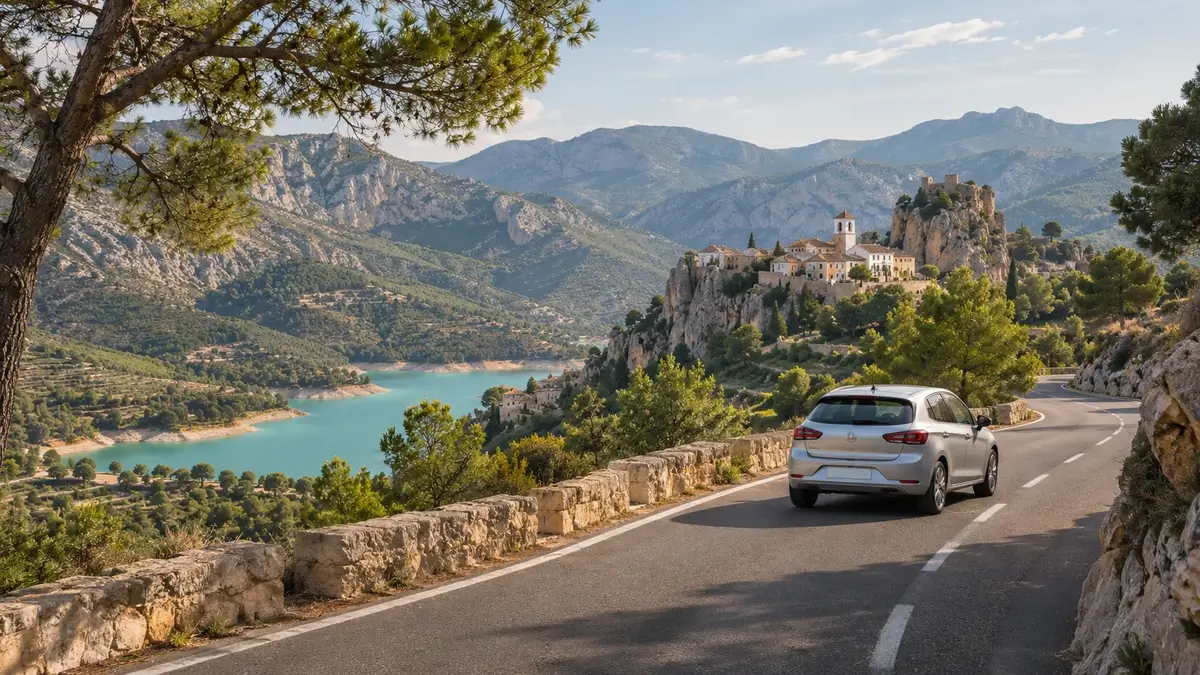
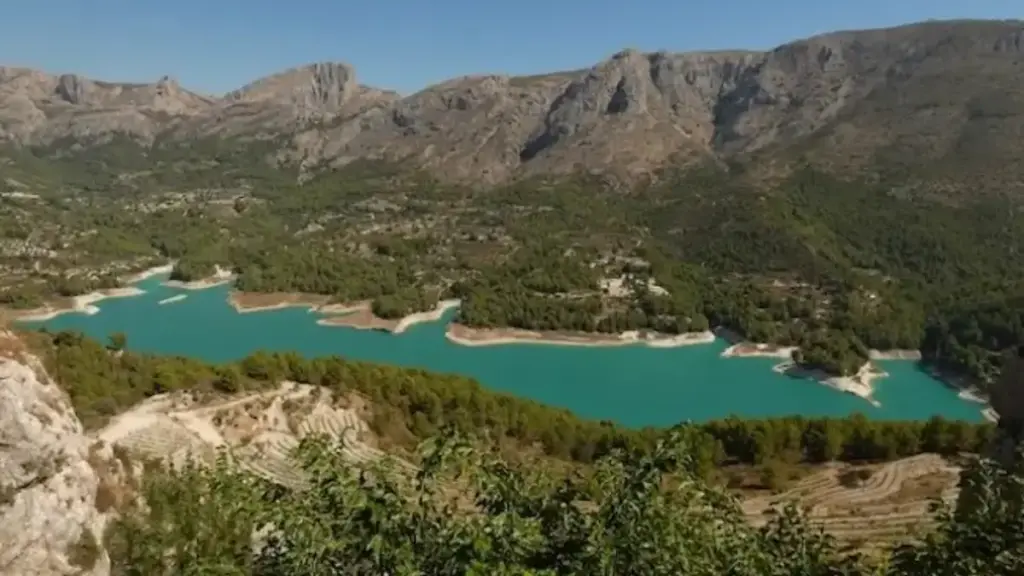
Guadalest is one of the most memorable Alicante road trips because the scenery changes quickly: coast, citrus valleys, then mountain roads and a village perched above a turquoise reservoir. The drive is not difficult in good weather, but the final approach is winding, so allow more time than the distance suggests.
In Guadalest, park in the designated areas and walk up into the old village. The castle viewpoint is the reason to come: you look down over the reservoir and across the surrounding mountains. The village is compact, so you do not need a long itinerary.
Fonts de l’Algar, near Callosa d’en Sarrià, combines naturally with Guadalest if you start early. The waterfalls and natural pools are popular in summer, so check access conditions before you go and expect a busier, more managed experience in peak season. For a calmer day, visit Guadalest first, have lunch in the area, then continue to Algar in the afternoon.
Villajoyosa and Altea: the best relaxed coastal route
For a coastal day that is not just about lying on a beach, combine Villajoyosa and Altea. Villajoyosa is close to Alicante and known for its colourful houses along the seafront. It is a simple first stop for a coffee, a beach walk and photos without committing to a long day.
From there, continue north towards Altea. The old town climbs from the lower streets to a church square with sea views, white façades and narrow lanes. It is one of the prettiest places to visit near Alicante by car, but parking near the old town can be tight, so use signed car parks lower down and walk up.
You can add Benidorm if you want a bigger resort stop on the same route, although it changes the tone of the day. For more ideas in that area, the guide to Benidorm beaches and day trips is a useful next read.
Calpe: beaches, viewpoints and the Peñón de Ifach
Calpe is a strong choice if you want a proper Costa Blanca seascape. The town sits around the Peñón de Ifach, the huge limestone rock that dominates the skyline and gives the coast its most recognisable profile.
A simple day plan is to drive from Alicante to Calpe, walk the promenade, visit the area around the salt flats, and enjoy views of the Peñón from the beaches. If you want to hike in the natural park, check current access rules and conditions before setting off, because paths and visitor numbers can be managed for safety and conservation.
Calpe can also be combined with Moraira for a more scenic coastal loop, but do not overpack the day. In summer, one main town plus a beach stop is usually more enjoyable than trying to tick off every cove on the map.
Santa Pola and Tabarca: a short drive plus an island trip
Tabarca is often described as an Alicante day trip, but by car the practical way to do it is to drive to Santa Pola, park, and take a boat from there. Santa Pola is close to Alicante, so this route keeps the driving light and leaves more time for the island.
Before you go, check boat times, sea conditions and return schedules. Services are much more frequent in the warmer months, while winter crossings can be limited or more weather-dependent. On the island, the main pleasures are simple: clear water, a small village, coastal paths and a long lunch.
If you do not take the boat, Santa Pola still works as a half-day trip. The salt flats, harbour area and nearby beaches make it a low-effort option, especially with children or a later start.
Alcoy and Font Roja: inland scenery and cooler mountain air
Alcoy offers a completely different side of the province. Instead of beaches and promenades, you get bridges, ravines, modernist buildings and access to mountain landscapes. The drive inland from Alicante is manageable, making it one of the best day trips from Alicante when the coast feels too hot or crowded.
Font Roja Natural Park is the main nature stop nearby. It is especially appealing in spring and autumn, when walking is more comfortable and the landscape has more colour. In summer, go early, carry water and avoid walking during the hottest part of the day.
This is a good route for travellers who prefer viewpoints, short hikes and local restaurants to beach time. Parking and road space are generally easier than in the most popular coastal towns, but natural park access can still be limited at busy times.
Torrevieja and the salt lagoons: an easy southbound drive
South of Alicante, Torrevieja is a practical day out for beaches, promenades and salt lagoon viewpoints. The famous pink tones of the Laguna Rosa depend on light, season and conditions, so do not expect the colour to look identical every day.
Use marked viewpoints and paths, and do not enter restricted salt lagoon areas. These landscapes are working and protected environments, not swimming spots. For swimming, choose the beaches and coves along the coast instead.
This route is easy to combine with a stop in Guardamar del Segura, especially if you want dunes, pinewoods and a more relaxed beach atmosphere before or after Torrevieja.
Murcia or Cartagena: longer city day trips from Alicante
If you are happy with more time on the road, Murcia makes a rewarding cultural day trip. The cathedral area, old streets, squares and riverside walks give you a full urban day without needing an overnight stay. It is best if you enjoy architecture, tapas stops and wandering rather than beach time.
Cartagena is farther but still possible as a long day trip by car. Its Roman theatre, harbour setting and historic military sites make it one of the most interesting cities within reach of Alicante. Start early, use a central car park, and avoid planning a late return if you do not like night driving.
Between the two, Murcia is easier and shorter; Cartagena is more distinctive but asks for a longer day. Both are better outside the hottest hours of midsummer, when city sightseeing becomes tiring quickly.
Which Alicante day trip should you choose?
Choose based on the kind of day you want, not just distance. For the easiest outing, pick Elche or Santa Pola. For mountain views, choose Guadalest. For a classic Costa Blanca coast day, choose Villajoyosa, Altea or Calpe. For walking and cooler inland air, choose Alcoy and Font Roja.
If you are travelling with children, avoid routes with too many short stops and parking changes. Elche, Santa Pola, Villajoyosa and Calpe are simpler. If you are travelling as a couple or with friends who enjoy scenic drives, Guadalest, Altea and Font Roja feel more special.
For first-time visitors, the best all-round choice is probably Guadalest with either Fonts de l’Algar or Altea, depending on whether you prefer waterfalls or a coastal old town. It shows you quickly that Alicante is not just a city-and-beach destination.
FAQ
Do you need a car for day trips from Alicante?
You do not need a car for every trip, but a car gives you far more flexibility for Guadalest, Fonts de l’Algar, Font Roja, small coves and multi-stop coastal routes. Trains and buses work better for simple city-to-city journeys.
What is the closest day trip from Alicante by car?
Elche and Santa Pola are among the closest worthwhile day trips. Both are around a short drive from Alicante and can work as half-day outings.
Can you visit Guadalest and Altea in one day?
Yes, you can visit Guadalest and Altea in one day if you start early and do not add too many extra stops. Visit Guadalest first, then drive down towards the coast for Altea in the afternoon.
Are Alicante road trips difficult for foreign drivers?
Most routes are straightforward, especially on main roads. The main things to watch are right-hand driving, roundabouts, blue-zone parking rules, narrow old-town streets and winding mountain roads near inland villages.
What is the best season for Alicante day trips?
Spring and autumn are usually the most comfortable for driving, walking and sightseeing. Summer is excellent for beaches and boat trips, but parking and traffic are busier, especially in coastal towns and at weekends.

Laura is a Costa Blanca–based travel and lifestyle writer with over five years of experience living in Spain. She specializes in authentic travel experiences, coastal destinations, and practical insights into everyday local life across the region.
View profile →